2026-10-22 14:39:47
CTEK for standby vehicles: Ambulances, security and response fleets
Standby vehicles need to start when the call comes in. There is no room for delay, no room for uncertainty and no room for weak battery performance when a vehicle is expected to respond.
That is why CTEK battery chargers matter for ambulances, security vehicles and response fleets. These vehicles often spend long periods parked, but they carry heavy electrical demand. Radios, tracking systems, lighting, onboard equipment, alarms and standby electronics can all place pressure on the battery before the vehicle even moves.
For dealers, workshops, auto electricians and fleet support businesses, this creates a clear opportunity. Standby fleets need more than battery replacement. They need proper battery care, consistent maintenance routines and charging solutions that help vehicles stay ready.
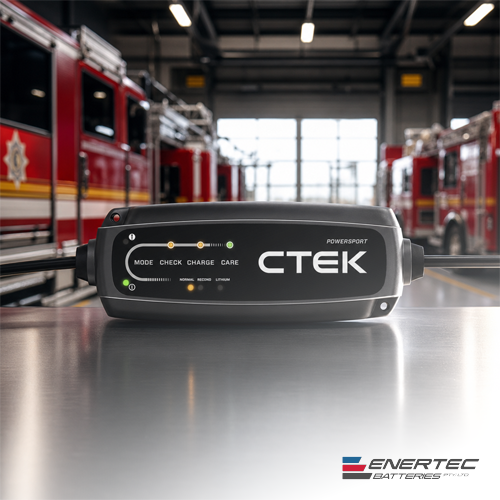
Enertec supports this market with CTEK battery chargers that help trade businesses recommend smarter charging solutions for demanding fleet environments. When vehicles are expected to respond at any time, battery care becomes part of operational readiness.
Why standby vehicles need smarter charging
A standby vehicle has a different battery life from a normal passenger vehicle. It may not drive daily or long enough to fully recharge the battery through the alternator. It may sit at a base, office, depot, clinic, guard house or response point while onboard systems continue to draw power.
This is common in emergency and support environments. Ambulances may be stationed between callouts. Security vehicles may idle, patrol in short shifts or stand at a site for extended periods. Response vehicles may be ready for urgent dispatch, but may not travel far enough each day to restore full battery charge.
Over time, this creates battery stress. The vehicle may start slower, the battery may lose capacity or the team may only discover the problem when the vehicle is needed most.
CTEK battery chargers help reduce this risk by supporting smart charging and maintenance. They are designed to help keep batteries charged, conditioned and ready for use, instead of only reacting once a battery has already failed.
The real cost of a flat standby vehicle battery
A flat battery in a normal vehicle is inconvenient. A flat battery in a standby fleet vehicle can affect service delivery, safety and customer trust.
For ambulance operators, a no-start situation can delay urgent medical response. For security companies, it can affect patrol reliability, incident response and client confidence. For technical response fleets, it can delay support teams when customers are waiting.
The cost is not only the battery. It includes downtime, technician callouts, replacement costs, operational pressure and reputational damage.
This is why dealers and workshops should position CTEK battery chargers as a readiness solution, not just an accessory. For standby vehicles, charging support can help protect the vehicle, the team and the service promise behind the fleet.
Where CTEK battery chargers fit into fleet maintenance
CTEK battery chargers can play a valuable role across different fleet environments. The exact charger recommendation depends on the vehicle type, battery size, voltage, usage pattern and workshop process.
Ambulances
Ambulances carry demanding electrical loads. Emergency lighting, medical equipment, communications systems and auxiliary devices can all increase battery pressure. Even when a vehicle is not moving, it may still need power for onboard systems.
For ambulance operators, battery reliability is part of readiness. Workshops that maintain ambulance fleets can use CTEK battery chargers to support regular charging routines, pre-shift checks and battery maintenance during downtime.
Security vehicles
Security fleets often work in demanding patterns. Vehicles may patrol for short distances, stand at sites or respond to alarms at unpredictable times. Many also run radios, trackers, dash cameras, light bars and other security equipment.
This kind of use can lead to incomplete charging. A CTEK charging routine can help security companies keep vehicles ready between shifts and reduce unexpected battery failures.
Response fleets
Response fleets include technical support vehicles, roadside assistance units, emergency contractors, maintenance teams and backup service vehicles. These vehicles are expected to move quickly when needed, but may stand between callouts.
For these fleets, battery care supports uptime. A smart charger can help keep batteries ready while vehicles are parked and reduce the chance of a delayed response caused by a weak battery.
How dealers and workshops can recommend the right CTEK charger
The best recommendation starts with the right questions. Dealers and workshops should avoid selling one charger for every fleet situation. Instead, the conversation should focus on the vehicle and the way it operates.
What type of vehicle is in the fleet?
A small response vehicle does not have the same charging requirement as a large ambulance or commercial support vehicle. The vehicle size, battery capacity and electrical demand should guide the charger recommendation.
Does the vehicle use 12V or 24V battery systems?
Some fleet and commercial vehicles may use 24V systems. This must be confirmed before a charger is recommended. Correct voltage matching protects both the battery and the vehicle.
How long does the vehicle stand between trips?
Vehicles that stand for extended periods benefit strongly from maintenance charging. This is especially important for standby fleets that must remain ready even when they are not driven daily.
What additional equipment draws from the battery?
Radios, trackers, cameras, lights and auxiliary equipment can all place extra demand on the battery. The more equipment fitted, the more important it becomes to manage charging properly.
Is the charger for home base, workshop or mobile support?
Some chargers are used in a workshop. Others may be kept at a depot, response base or fleet yard. The environment affects the best product choice, cable setup and charging process.
These questions help trade teams recommend CTEK battery chargers with confidence and reduce the risk of incorrect fitment or poor customer expectations.
Why CTEK supports better battery life
A battery does not only fail because it is old. It can also fail because it is undercharged, overworked or left standing for too long without proper maintenance.
Smart charging helps manage this more effectively. CTEK battery chargers are designed to support controlled charging processes that help maintain battery condition. For fleet customers, this means charging becomes part of prevention rather than a last-minute rescue.
When a battery is maintained correctly, the customer has a better chance of avoiding unnecessary early replacements. For dealers and workshops, this creates trust. It shows that the recommendation is focused on performance and long-term value, not only the next sale.
The dealer opportunity in standby vehicle charging
CTEK battery chargers give dealers and workshops a strong way to support fleet customers beyond battery replacement.
A customer may come in for one weak battery, but the real opportunity is to review the whole standby fleet. How many vehicles stand between shifts? How many have accessories drawing power? How many batteries are replaced too early? How often are vehicles tested before duty?
These questions open the door to charger sales, maintenance routines and stronger business relationships.
For auto electricians and workshops, CTEK can also support service quality. Vehicles can be connected to chargers during diagnostics, battery checks or maintenance work. This helps protect electronic systems and keeps the vehicle in a more stable battery condition while work is being done.
For dealers, CTEK is a strong add-on sale with automotive batteries. When a fleet buys batteries for standby vehicles, the right charger should be part of the same conversation.
Why choose Enertec for CTEK battery chargers
Enertec gives dealers and workshops access to CTEK battery chargers as part of a broader battery and power support ecosystem. This matters because standby vehicle customers often need more than one solution. They may need vehicle batteries, workshop chargers, maintenance chargers, UPS batteries or standby power support for sites and equipment.
By working with Enertec, dealers can build a stronger offering for customers who depend on power reliability. Enertec supports the trade with recognised brands, a wide product range and a dealer-focused approach that helps battery businesses grow.
Dealers can explore the available CTEK range from Enertec and use it to support workshops, fleet customers, standby vehicles and battery maintenance programmes.
How to position CTEK to fleet customers
The strongest message is simple: ready vehicles need ready batteries.
When speaking to fleet customers, dealers and workshops should focus on operational confidence. CTEK battery chargers can help keep vehicles prepared between jobs, protect battery investment and reduce avoidable callouts caused by weak batteries.
This message is especially powerful for ambulances, security companies and response teams because uptime is directly linked to service delivery. The charger is not a luxury item. It is part of the readiness plan.
Keep standby vehicles battery-ready with Enertec and CTEK
Standby vehicles carry a serious responsibility. Whether it is an ambulance, a security vehicle or a response fleet, the battery must be ready when the vehicle is needed.
CTEK battery chargers help dealers and workshops support that readiness with smarter battery care, better maintenance routines and stronger customer education. They help move the conversation from emergency replacement to proactive protection.
For trade businesses, this is a valuable category. It supports add-on sales, fleet relationships, workshop efficiency and long-term customer trust. With Enertec as your supply partner, your business can offer CTEK charging solutions that meet real operational needs in South Africa.
Explore the CTEK range from Enertec or take the next step and become an Enertec dealer today.