2026-06-02 21:00:04
The Ultimate Guide to Mining Equipment Batteries
A Trade-Focused Guide to Heavy-Duty Starting Power for Mining Fleets, Contractors, Hire, OEM Channels and Dealers
Introduction
In mining, a flat battery isn’t a small operational hiccup; it’s a productivity event. When a haul truck, excavator, dozer, drill, loader, or service vehicle won’t start, the impact can ripple across an entire shift: delayed production cycles, idle crews, missed blasting windows, disrupted haul routes, and avoidable recovery costs.
Mining equipment batteries work in some of the harshest conditions on earth. They face constant vibration, extreme dust, wide temperature swings, high under-bonnet heat, and long idle periods (especially for standby units, seasonal operations, or equipment waiting on parts).
Add harsh wash-down routines, exposure to corrosion in certain regions, and parasitic drain from onboard electronics, and premature battery failure becomes one of the most common, most preventable causes of downtime.
This guide is written specifically for the mining equipment value chain, including:
-
Battery dealers and resellers who need the right stock mix and fewer returns
-
OEM / OE equipment sellers who commission machines and need handover reliability
-
Used mining equipment sellers who refurbish assets and must ensure yard-start readiness
-
Large mining companies and fleet operators focused on uptime, standardisation and cost control
-
Mining contractors and hire businesses managing high turnover, mixed operator behaviour and idle-time sulfation risk
Whether you’re supplying batteries into the channel, fitting them in a workshop, managing a site, or delivering machines to end users, the goal is the same: spec the correct battery, install it correctly, and maintain charge health so equipment starts every time.
Who This Guide Is For
This article focuses only on mining equipment and mining site support machinery, including production plant, mobile mining equipment, and essential site utilities.
It is designed for:
-
Dealers & resellers: choosing stock ranges, advising customers, avoiding incorrect fitment returns
-
OEM / OE equipment sellers: pre-delivery inspection (PDI), commissioning, delivery readiness and warranty protection
-
Used equipment sellers: recon/refurb processes, yard storage, “ready-to-start” sales standards
-
Fleet operators: uptime targets, preventative maintenance, consistent specs across mixed fleets
-
Contractors & hire fleets: fast turnaround, idle-time maintenance, battery abuse reduction and fewer callouts
Why Mining Equipment Battery Selection Is Commercially Critical
In mining, time is money, and most mining operations measure performance by tonnes moved, metres drilled, or hours of productive runtime. A non-start event can:
-
Stall production equipment at shift change
-
Delay haul cycles and loading sequences
-
Increase recovery and callout costs (especially in remote areas)
-
Trigger safety risks during jump-starting or ad-hoc battery handling
-
Create avoidable maintenance backlog and asset availability issues
Unlike passenger vehicles, mining equipment often demands high cranking power, operates in continuous vibration, and may sit idle with electronics drawing power. Battery selection is not a price decision; it’s a reliability, safety, and uptime decision.
Typical Use Cases in Mining
Mining batteries are used across a wide range of heavy-duty machinery and site support equipment.
1. Production and Load & Haul Equipment
-
Haul trucks
-
Front-end loaders
-
Excavators
-
Dozers
-
Graders
These machines experience:
-
Heavy vibration and shock loading
-
High diesel compression requirements
-
Hot engine bays and long duty cycles
-
Dust ingress and harsh site conditions
2. Drilling and Support Equipment
-
Drill rigs (surface)
-
Utility/support units for drilling operations
-
Light plant supporting drilling areas
Often characterised by:
-
Repeated engine starts
-
High vibration and intermittent operation
-
Remote deployment and exposure to elements
3. Underground and Specialised Operations
Depending on site type and safety requirements, operations may include:
-
Underground service vehicles and support equipment
-
Equipment exposed to high humidity, water ingress risk, and corrosion factors
(Exact battery specs and safety requirements can vary significantly by site policy and OEM guidelines.)
4. Contractor and Hire Fleets
Contractors and hire businesses face:
-
Assets standing between contracts
-
Mixed operator behaviour
-
Inconsistent charging discipline
-
Higher incidence of deep discharge and jump-start reliance
Common Causes of Battery Failure in Mining Equipment
Battery failures in mining are rarely “random”. They are usually predictable outcomes of environment + duty cycle + incorrect specification or maintenance.
1. Extreme Vibration and Shock
Rough haul roads, tracked equipment, and continuous operation can lead to:
-
Plate shedding
-
Internal strap cracking
-
Early-life internal shorts (especially when batteries are not correctly secured)
2. Heat Stress and Thermal Cycling
High ambient temperatures and hot engine bays accelerate:
-
Grid corrosion
-
Electrolyte loss in flooded batteries
-
Increased internal resistance and reduced cranking output
3. Dust, Moisture, and Wash-Down Exposure
Mining sites can be extremely dusty, but also subject batteries to:
-
High-pressure wash-down
-
Water and chemical exposure, depending on site processes
-
Terminal corrosion and leakage pathways
4. Deep Discharge and Long Idle Periods
Idle equipment suffers from:
-
Parasitic drain from electronics and telematics
-
Sulfation from partial-state-of-charge storage
-
Capacity loss that looks like “weak batteries”
5. Incorrect Charging Practices
Overcharging can:
-
Overheat batteries and accelerate wear
-
Increase water loss and shorten life
Undercharging can:
-
Accelerate damaging sulphation
-
Reduce usable capacity
-
Create repeat non-starts after “new battery” installations
6. Incorrect Battery Selection
Common mining-specific mistakes:
-
Automotive/light commercial batteries used in heavy plant
-
Undersized CCA for high-compression diesel engines
-
Wrong terminal layout causing cable strain or unsafe routing
-
Poor hold-down fitment leading to vibration damage
In mining, many battery failures are actually specification, installation, or maintenance failures.
Battery Guidance by Audience
1. For Dealers and Battery Resellers
For dealers, the biggest commercial risk is incorrect specification. Many “warranty” claims are tied to a wrong-fit supply or the battery being used in an environment it wasn’t built for.
Common causes of returns:
-
Undersized CCA for large diesel engines
-
Incorrect physical size / hold-down mismatch
-
Wrong terminal layout leading to cable strain and terminal damage
-
Battery sold into standby equipment with no maintenance charging plan
Dealer best practice:
-
Sell by application (machine class + voltage + environment + duty cycle), not by price
-
Standardise a counter checklist: voltage (12/24V), terminal layout, hold-down type, CCA requirement
-
Recommend a maintenance strategy for equipment that stands
-
Create a “site-ready” offering: supply + fitment guidance + charging advice
Dealer outcome: fewer comebacks, fewer disputes, stronger trust with fleet buyers.
2. For OEM / OE Mining Equipment Sellers (New Machine Sales & Commissioning)
OEM and OE sellers must ensure the battery supports commissioning, PDI, and handover. Machines may stand in yards, undergo short moves, or remain idle while awaiting attachments, approvals, or transport, which often doesn’t recharge batteries adequately.
Where battery problems show up:
-
Machines delivered to the site with marginal starting performance
-
Yard storage discharge and sulfation before handover
-
Parasitic drain from electronics during idle time
Best practice for OEM/OE sellers:
-
Include battery checks in the PDI (voltage + basic health assessment)
-
Confirm the correct specification for engine requirements and the operating environment
-
Avoid leaving machines parked without maintenance charging
-
Treat battery readiness as warranty and reputation protection
OEM/OE outcome: fewer handover failures, fewer early-life battery claims.
3. For Used Mining Equipment Sellers and Refurb / Recon Yards
Used equipment sellers win deals when machines are ready-to-start, ready-to-work, especially when buyers are comparing multiple units, and reliability is part of the perceived value.
Common recon-yard realities:
-
Batteries sit partially discharged and sulphate
-
Terminal corrosion is common from outdoor exposure and wash-down
-
Hold-downs and trays may be damaged or missing
-
“Starts today” doesn’t mean “reliable under load”
Recommended recon standard:
-
Test battery health as part of recon (not only voltage)
-
Replace or recondition batteries that can’t hold a charge under load
-
Clean/protect terminals; check clamps and correct securing
-
Implement a maintenance charging routine for yard stock awaiting sale
Used equipment outcome: reliable demonstrations, fewer post-sale disputes, stronger brand credibility.
4. For Large Mining Companies and Fleet Operators
For fleet operators, the battery is part of a larger uptime system. The goal is to reduce non-start events and avoid reactive maintenance.
Fleet reliability is driven by systems:
-
Standardisation reduces wrong-fit errors and simplifies spares
-
Preventive checks catch weak batteries before shift-critical failures
-
Correct spec reduces starter strain and repeat callouts
-
Charging discipline prevents sulfation across standby assets
What fleets should implement:
-
Standard battery specs per machine class (where practical)
-
Scheduled checks: terminals, securing, voltage under realistic conditions, cranking performance
-
Idle asset SOP: disconnect protocols where appropriate or structured maintenance charging
-
Installation SOP: correct hold-downs, cable routing, post-fit checks
Fleet outcome: higher asset availability, fewer callouts, predictable replacement cycles.
5. For Contractors and Hire Fleets
Contractors and hire fleets often experience the highest battery stress: mixed operators, frequent dispatch cycles, long idle periods between contracts, and harsh site conditions.
Why contractor/hire batteries fail early:
-
Deep discharge during idle periods
-
Repeated jump-starting instead of proper recovery
-
Inconsistent maintenance routines across sites
-
Vibration damage when batteries aren’t secured correctly
Depot/site best practice:
-
“Return-to-yard” or “end-of-shift” checks for key assets
-
Maintenance charging routines for idle units and standby equipment
-
Identify weak batteries early to reduce callouts
-
Enforce correct securing and terminal condition checks before dispatch
Contractor/hire outcome: fewer breakdown callouts, faster turnaround, fewer disputes.
Mining Equipment Battery Technologies Explained
Before selecting a product, understand what each technology is designed to handle.
Reinforced Flooded Lead-Acid (Heavy-Duty Industrial)
Still widely used for heavy mining equipment due to its strong cranking and practicality.
Advantages:
-
High CCA for large diesel engines
-
Proven performance in heavy-duty applications
-
Cost-effective at scale
Limitations:
-
Vulnerable to vibration damage if not reinforced and secured
-
Suffers when repeatedly undercharged
-
Heat accelerates ageing if the charging discipline is poor
Lead-Calcium Technology
Common in modern heavy-duty batteries.
Benefits:
-
Reduced water loss
-
Lower self-discharge (useful for standby equipment)
-
Improved corrosion resistance
-
Better heat tolerance than older designs
Silver Calcium Technology
Enhanced durability for harsher environments.
Benefits:
-
Improved high-temperature performance
-
Better conductivity and cranking stability
-
Stronger resilience under harsh operating cycles
AGM (Absorbent Glass Mat)
AGM may be used in certain higher-electronics applications or specific equipment types, but it is not always the default for heavy plant due to cost and charging sensitivity in some real-world conditions.
Rule of thumb: match technology to duty cycle, environment, and site practices, not price.
How to Choose the Right Mining Equipment Battery
Use this checklist to reduce wrong supply and repeat failures:
Step 1: Confirm Voltage
Most mining equipment uses:
-
12V systems
-
24V systems (often dual 12V batteries in series)
Step 2: Confirm CCA Requirement
Diesel engines need high cranking performance.
Undersized CCA leads to:
-
Slow crank and non-starts
-
Starter motor strain
-
Repeated failures that look like “bad batteries”
Step 3: Match Physical Configuration
Confirm:
-
Case size and footprint
-
Hold-down and tray design
-
Terminal layout and polarity
-
Cable routing and strain (no tension on terminals)
Step 4: Assess Site Reality
Ask:
-
High heat or significant thermal cycling?
-
Continuous vibration/shock loading?
-
Extended idle time between shifts/contracts?
-
Frequent wash-down exposure?
-
Remote operation requiring maximum reliability?
Step 5: Align Charging Discipline
A correct battery without a charging plan still fails early, especially on standby assets.
Signs a Mining Equipment Battery Is Failing
Watch for:
-
Slow crank (especially at shift start)
-
Voltage drop under load
-
Frequent jump-starting
-
Corrosion at terminals and cable ends
-
Swollen casing or heat distortion
-
Starts after charging but fails again quickly
These signals typically indicate the need for replacement or corrective action, not “wait and see”.
Mining Equipment Battery Ranges Available Through Enertec
Enertec’s range strategy is application-based: match build quality and technology to the realities of mining work, vibration, heat, idle time, and diesel cranking demand.
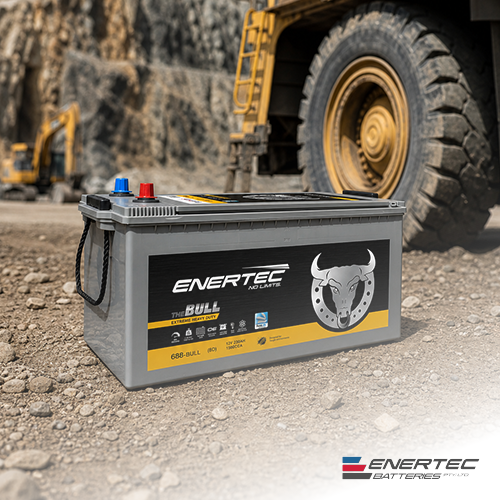
Enertec Bull Range – Heavy-Duty Industrial Performance
Designed for harsh environments where durability matters most.
Typical suitability:
-
High-vibration equipment
-
Heavy diesel cranking requirements
-
Demanding duty cycles
Key features (application-led):
-
Strong cranking performance
-
Durability-focused construction for harsh environments
-
Improved resilience to heat and vibration compared to light-duty options
CTEK Charging Support for Mining Applications
Even industrial batteries require correct charging to avoid sulfation and early-life failure, especially in fleets, yards, and remote sites where equipment stands.
Why Charging Matters in Mining
Improper charging is one of the most common drivers of premature failure:
-
Undercharging causes sulphation and capacity loss
-
Overcharging accelerates heat damage and internal wear
-
Inconsistent “boosting” creates short-term starts but long-term decline
Where Intelligent Charging Adds Value
Workshops and fleet teams can use structured charging to:
-
Maintain standby assets and reduce non-start events
-
Recover deeply discharged batteries where appropriate
-
Reduce reliance on jump-starting
-
Reduce battery-related comebacks and disputes
If your operation includes standby equipment, idle assets, remote deployment, or intermittent generator use, charging discipline is part of the system.
Why Choose Enertec as Your Mining Equipment Battery Distributor
Enertec supports trade supply with a mining-relevant approach:
-
Wholesale distribution suited to dealers, workshops, fleets and contractors
-
Application guidance and product matching support
-
Consistent availability across core ranges
-
Cross-category supply opportunities (batteries + charging solutions)
-
Trade-oriented support that helps reduce incorrect fitment and repeat issues
For businesses, the goal is reliability at scale, not just individual sales.
Frequently Asked Questions
What voltage do most mining machines use?
Commonly 12V or 24V systems, with many 24V systems configured as dual 12V batteries in series.
Why does a battery show good voltage but still not crank?
Voltage alone doesn’t confirm cranking capability. Sulphation and internal resistance can reduce available current even when voltage looks acceptable.
How do I prevent standby equipment batteries from dying?
Implement an idle asset SOP: reduce parasitic drain where possible and use structured maintenance charging.
What causes repeated battery failures in contractor fleets?
Usually deep discharge, idle-time sulfation, poor securing, and repeated jump-starting without proper recovery.
How long should a mining equipment battery last?
Service life depends on duty cycle, environment, securing, and charging discipline. Correct spec + maintenance significantly improves life and reduces non-start events.
Powering Mining Reliability
Mining operations depend on consistent uptime, safe work practices, and reliable assets. Battery reliability is a key part of that system. When you choose the correct battery specification, secure it properly, and maintain charge health across standby and active equipment, you reduce breakdowns, cut callouts, protect warranties, and keep production moving.
Whether you are a dealer, an OEM/OE seller, a used equipment yard, a fleet operator, or a contractor/hire business, the objective is the same: machines that start on demand, without drama.