2020-11-10 11:23:27
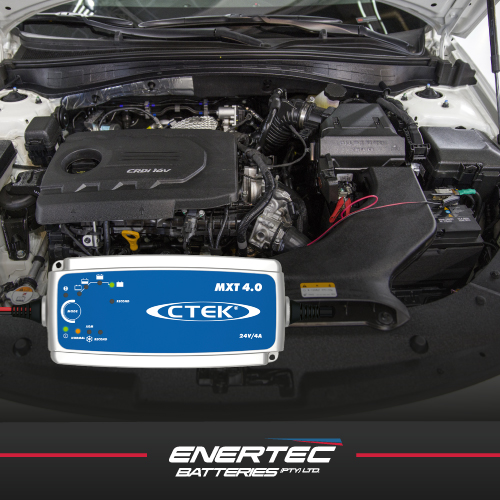
MXT 4.0 CTEK Battery Charger
In the world of automotive batteries, the 12V battery is more common compared to 24V batteries. That being said, the importance of 24V batteries cannot be understated. They are generally used in trucks and pickups which are ultimately used for commercial purposes. That is why their maintenance is highly important. An integral tool needed for maintaining a 24V battery is the battery charger. Enertec realizes the significance of such chargers and aims to create awareness about them among vendors. Today, our focus would the MXT 4.0 charger which is an offering CTEK specifically designed for 24V batteries. We would look at its different modes and settings in order to develop an understanding about its use and functionality.
Designed for smaller 24V batteries, the MXT 4.0 is the ideal charger for batteries found in wheelchairs, smaller construction machinery and pickups. It comes with different specialised modes that make the charger useful in different conditions. The AGM is designed to charge AGM batteries specifically. Recond mode is used to revive deeply discharged batteries while the supply mode allows to take the battery out for inspection without disrupting the supply to the electronic systems. Its different safety features, which include short circuit protection, spark-free charging and reverse polarity protection, makes the MXT 4.0 a trustworthy choice for both technicians and customers alike. (NB - Recond function should never be used on AGM Batteries)
Before looking at a breakdown of the charging steps, let us have a look at the technical data of MXT 4.0. The charger has 3 different maximum charging currents and charging voltages for 3 different modes. 4A/28.8V for the normal mode, 4A/29.4V for the AGM mode and 1A/31.4V for the recond mode. The charger follows the 8-step automatic charging cycle and it is designed for 24V lead-acid batteries. It can charge batteries with capacities ranging from 8Ah to 100Ah. The range increases to 250Ah when it comes to charging the battery for maintenance purposes. It has a IP65 rating which makes it splash and dust resistant. It comes with a 2-year warranty.
The charging process of the MXT 4.0 comprises of the following 8 steps:
- The first step performs desulphation. This is basically the process of removing any sulfate deposits on the plates of the battery. By doing so, it restores the charge holding capacity of the battery.
- Once the desulphation is completed, the charger performs a soft start on the battery. The purpose of the soft start is to check if the battery is capable of accepting charge. If results are OK, then the charging process begins.
- Initially, the charging is done in bulk. In other words, the maximum charging current is used for charging the battery until it reaches 80% of its full capacity.
- Beyond the 80% charge level, the charging shifts to absorption. This implies a gradual decrease in charging current until the battery reaches 100% charge level.
- Upon completion of the charging process, an analysis of the battery’s charge holding capacity is done. If it is deemed that the battery cannot hold a charge, then it is best to replace the battery.
- Next, the charger runs the RECOND program. This program is used to revive deeply discharged batteries and it is useful for batteries that have been dead for a while.
- The last steps focus on the maintenance of battery and are the reasons why this charger is considered as a “plug and forget” solution. The battery is maintained at full charge level using a constant voltage charge or float charge.
- The final step makes use of pulse charging for maintenance of charge levels between 95% to 100%. It does so by monitoring the battery levels and provide a pulse of voltage if needed to keep the battery in its fully charged state.