
2026-03-25 18:13:36
The Ultimate Guide to UPS Batteries
A Dealer-Focused Guide to Backup Power Reliability, Battery Selection & Supply
In today’s power environment, uninterrupted power supply (UPS) systems are no longer optional; they are operationally critical.
Across South Africa, businesses face:
● Power instability
● Voltage fluctuations
● Unexpected outages
For facilities managers, IT departments, security companies, healthcare providers and commercial operators, backup power is directly linked to uptime, data protection and operational continuity.
For dealers and resellers, UPS batteries represent:
● Recurring replacement cycles
● Multi-battery installations
● Cross-sell opportunities (chargers, testing, monitoring)
● Long-term service contracts
● Strong margin potential in commercial accounts
However, incorrect battery selection or poor charging practices can lead to:
● Reduced runtime
● Premature failure
● Warranty claims
● Client dissatisfaction
● Costly downtime
Correct UPS battery specification is not just a technical issue; it’s a commercial one.
Typical Use Cases
UPS batteries are deployed across multiple commercial and industrial environments:
IT & Server Rooms
● Data centres
● Small business server racks
● Cloud infrastructure nodes
● Telecom cabinets
Demand profile:
Short-duration, high-reliability backup during outages. Batteries must deliver immediate discharge performance.
Healthcare Facilities
● Clinics
● Private hospitals
● Diagnostic equipment
● Pharmacy refrigeration
Demand profile:
Critical load backup where failure is not an option.
Security & Surveillance Systems
● Alarm systems
● CCTV networks
● Access control systems
Demand profile:
Frequent cycling in high load-shedding environments.
Financial & Retail Environments
● POS systems
● ATM machines
● Payment gateways
Demand profile:
Consistent short-cycle usage with high reliability requirements.
Industrial & Commercial Control Systems
● Automation panels
● PLC systems
● Manufacturing control environments
Demand profile:
Stable float charge with occasional deep discharge events.
Common Issues
UPS battery failures are rarely random. Most stem from specification or maintenance errors.
Common dealer-reported problems include:
1. Reduced Runtime
Clients complain that backup time has dropped significantly during outages.
Root causes:
● Capacity loss due to ageing
● Incorrect Ah specification
● Chronic undercharging
2. Premature Failure
Batteries are failing in 12–18 months instead of the expected 3–5 years.
Root causes:
● High ambient temperature
● Incorrect choice of product for the application
● Frequent deep discharge cycles
● Incorrect charging profile
● Poor ventilation
3. Swelling or Physical Damage
Often seen in sealed VRLA units.
Root causes:
● Overcharging
● Heat exposure
● Inferior quality batteries
4. Mismatched Battery Banks
Mixed brands or uneven ageing within multi-battery installations.
Result:
Uneven discharge, shortened system lifespan, increased warranty risk.
These issues prime the need for correct technology selection and system thinking.
UPS Battery Technologies Explained
UPS systems typically utilise Valve-Regulated Lead Acid (VRLA) batteries. Within this category, there are important distinctions.
AGM (Absorbent Glass Mat)
Characteristics:
● Electrolyte absorbed in glass mat separators
● Sealed and maintenance-free
● Strong high-rate discharge capability
● Low internal resistance
● Quick recharge time
Best suited for:
● Standard UPS systems
● Short-duration, high-current discharge
● Server rooms and telecom environments
Gel Batteries
Characteristics:
● Silica-based gelled electrolyte
● Better deep-cycle resilience
● Improved temperature tolerance
Best suited for:
● Frequent loadshedding / power interruptions
● Applications with repeated cycling
● Environments with an unstable power supply
Sealed Flooded Lead-Acid (in normal operating conditions – not excessive loadshedding periods)
Characteristics:
● Lower upfront cost
● Acceptable life expectancy but less than AGM and GEL
● Viable choice in budget restrained and non - critical applications
● Have been used successfully for over forty years in South Africa
Key Performance Considerations
When comparing technologies, dealers must consider:
● Float life expectancy
● Cycle life rating
● Operating temperature tolerance
● Discharge rate performance
● Recharge efficiency
● Expected life span
Technology must match usage patterns, not just price points.
How to Choose the Right UPS Battery
This is where dealer credibility is built.
Step 1: Confirm Voltage Requirements
Most UPS systems operate in:
● 12V units (small systems)
● 24V configurations
● 48V banks
● Larger higher voltage multi-battery racks
Always match manufacturer specifications.
Step 2: Capacity (Ah) Selection
Consider:
● Required runtime
● Load (Watt demand)
● Discharge depth expectations
● Frequency of outages
Underspecification leads to constant deep discharge, dramatically shortening lifespan.
Step 3: Operating Environment
● Ambient temperature
● Ventilation
● Rack spacing
● Enclosure size
Heat is the single biggest lifespan reducer in UPS batteries.
Step 4: Charging Compatibility
Ensure:
● Correct float voltage
● Multi-stage charging capability
● Temperature compensation, where possible
Incorrect charging algorithms is a primary cause of warranty claims.
Step 5: Replacement Strategy
In multi-battery banks:
● Replace the full set where possible ( batteries connected in series will never equalise when random batteries are replaced in a string)
● Avoid mixing old and new units
● Maintain brand/ ah capacity / batch consistency
Signs that a UPS Battery Is Failing
Dealers should educate clients to look for:
● Noticeably reduced backup runtime
● UPS alarm warnings
● Voltage drop under load
● Swollen casing
● Excessive heat during charging
● Inconsistent performance during outages
Proactive replacement prevents emergency callouts and protects the dealer's reputation.
UPS Battery Brands Available Through Enertec
Enertec aligns brands according to application suitability and performance requirements.
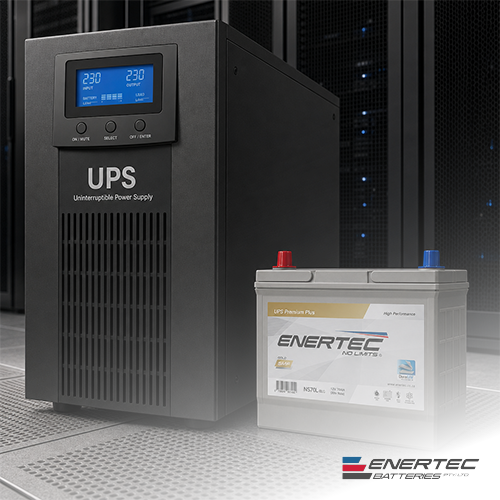
Enertec Branded UPS Batteries ( Enertec GOLD)
· NS40 – 12v 40ah
· NS60 – 12v 50ah
· NS70 – 12v 70ah
· 1150 - 12v 100/ 105ah
Positioned for:
● Reliable commercial performance
● Consistent quality control
● Strong warranty backing
● Competitive dealer margins
Ideal for:
● Standard business UPS installations
● Security systems
● SME server environments
Forbatt UPS Batteries
AGM 12volt – 7ah – 100ah
GEL 12volt – 8ah & 100ah
Positioned for:
● Value-driven installations
● High-turnover environments
● Cost-sensitive projects
● Entry-level commercial backup systems
Strengths:
● Competitive price-to-performance ratio
● Suitable for smaller UPS units
● Ideal for security, alarm and light commercial use
● Accessible option for bulk replacements
Ideal for:
● Security installers
● IT resellers
● Budget-constrained projects
● High-volume 7Ah / 9Ah replacements
Forbatt allows dealers to compete in price-sensitive segments without compromising on essential VRLA performance standards.
CTEK Battery Chargers That Are Applicable
Proper charging extends lifespan and reduces warranty claims.
While many UPS systems include internal charging, external smart chargers are valuable for:
● Pre-installation charging
● Battery bank maintenance
● Testing and recovery
● Diagnostics
Multi-stage smart charging ensures:
● Correct bulk phase
● Safe absorption
● Controlled float stage
● Reduced sulfation
Correct charger selection protects both the battery and the dealer’s margin.
Why Choose Enertec as Your UPS Battery Supplier
The battery is the product.
The supplier is the risk mitigation partner.
Enertec provides:
● Stock Availability: Reliable access to fast-moving UPS battery sizes.
● National Distribution: Consistent supply across South Africa.
● Technical Support: Guidance on correct battery specification, technology alignment, and installation best practices.
● Dealer Enablement: Structured product ranges, brand alignment by application, and a margin-focused portfolio strategy.
● Warranty & After-Sales Support: Clear processes that reduce friction and protect dealer relationships.
For commercial clients, uptime matters.
For dealers, reliability of supply matters just as much.
Frequently Asked Questions
How long do UPS batteries typically last?
Under ideal float conditions: 3–5 years.
However, in high-cycle environments, the lifespan may be reduced significantly depending on the depth of discharge.
Can I replace only one battery in a multi-battery UPS bank?
It is not recommended. Mixing old and new batteries causes uneven discharge and shortens system lifespan.
What affects UPS battery lifespan the most?
● Heat
● Deep discharge frequency
● Incorrect Charging profile
● Underspecification
Do UPS batteries require maintenance?
VRLA batteries are sealed and maintenance-free, but they require proper charging and temperature control.
Quick Specification Summary
|
Typical Voltage |
Common Applications |
|
12V |
Small UPS units |
|
24V |
SME backup systems |
|
48V |
Rack systems |
|
Multi-bank |
Data centres & industrial |
Technology Match Guide
|
Environment |
Recommended Technology |
|
Server Room |
Enertrc Gold / Forbatt AGM |
|
Frequent Load Shedding |
Gel / High-cycle AGM |
|
Security Systems |
Enertec Gold / Forbatt AGM |
|
High Temp Area |
Gel (with ventilation control) |
Conclusion
UPS batteries are not simply backup components; they are business continuity assets.
In a market shaped by unstable grid supply and increasing digital dependency, the correct UPS battery specification directly impacts:
● Operational uptime
● Data protection
● Equipment longevity
● Client trust
● Dealer reputation
For dealers, integrators and facility suppliers, the opportunity lies not just in selling a replacement battery, but in positioning yourself as a reliability partner.
When you follow the right process…
Application → Problem awareness → Technology education → Correct specification → Brand alignment → Supplier support
…you reduce warranty risk, increase repeat business and strengthen long-term commercial relationships.
Enertec supports this process by providing:
● Application-aligned product ranges
● Consistent national stock availability
● Technical guidance
● Strong after-sales processes
● Margin-conscious brand positioning
In the UPS environment, failure is visible and immediate.
The right battery choice, backed by the right supplier, ensures that when the power goes out, your client’s business doesn’t.
And that is where dealer credibility is built.